Thesis
The useful public question is not which theory sounds complete. It is which timeline claims can be tied to source cards, which claims depend on official summaries, and which intervals still sit in open receipt slots.
This reconstruction starts from the archive's existing Epstein death evidence lane and the already published final-48-hours research page. It treats the records as a chain: official report, source-card render, file-window pointer, watch-status record, exhibit-list pointer, and open slot. That chain can support a careful reading of sequence and uncertainty. It cannot support a finished theory by itself.
Source provenance
Three source pages behind the final-48-hours lane
These are existing GAH source renders, now surfaced inline so readers can inspect the file-window, watch-status and autopsy-pointer records without leaving the investigation.

The render supports a narrow file-window claim. It is not treated as proof of continuous video coverage.
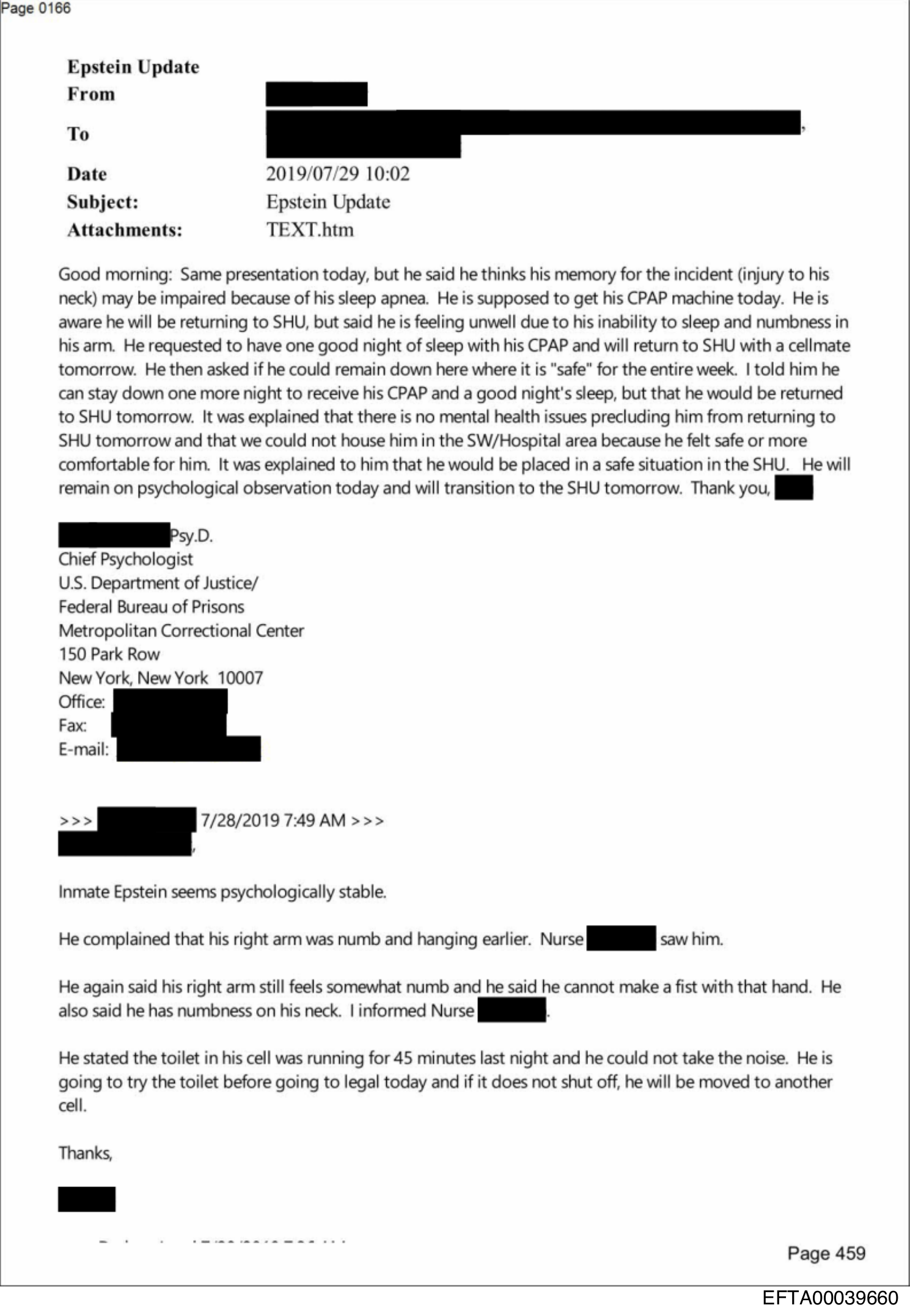
The rendered page is the watch-status receipt used in the archive’s source-line reconstruction.

The source render is an exhibit-list pointer; it is not substituted for the underlying autopsy record.
These source renders already existed in the GAH evidence lane; 063 surfaces them inside the published investigation rather than creating a duplicate story.
Key findings
The archive has an indexable final-48-hours research page and a separate proof-layer route for the Epstein death evidence lane.
EFTA00039025 is the official-report backbone currently used by the archive for several death-timeline claims.
EFTA00039416 supports a narrow file-window claim; it does not prove visual continuity or camera coverage.
EFTA00039660 supports a watch-status review lane; it does not by itself explain why a status changed or who understood it.
EMS and hospital timing remain open receipt slots unless a public primary source closes the interval.
Primary-source chain
Claim -> Source -> Bias -> Silence -> Confidence
Claim: The useful public question is not which theory sounds complete. It is which timeline claims can be tied to source cards, which claims depend on official summaries, and which intervals still sit in open receipt slots.
Source: the linked archive routes below are the source chain for this page.
Bias: this page is an archive-created editorial reading of public source routes. It favors source visibility and may understate interpretations that lack direct receipts.
Silence: anything not supported by the links below remains an unresolved question, not a hidden fact.
Confidence: moderate to high for route existence and narrow source descriptions; claim-specific confidence remains tied to each linked receipt.
Timeline
- Watch-status and custody context appear in the official-report and watch-status lanes.
- Attorney-log and will-context records belong to a source-chain lane, not a motive claim.
- CH0080 file windows and final-overnight timeline work require source-specific confidence labels.
- Autopsy and official-report materials become evidence about documentation and later findings, not a substitute for every missing primary record.
What could be read another way
An alternate reading is that the public records show administrative failure and incomplete record preservation rather than a hidden causal explanation. The archive should preserve that possibility because the same source cards that support sequence also leave intent, motive, and some timing questions unanswered.
What this page does not prove
- This page does not inspect private source files or databases.
- It does not infer video content from file names.
- It does not turn an official summary into a complete primary-source reconstruction.
- It does not claim who knew what at the time.
What still needs source work
- Which public source best fixes exact discovery, alarm, EMS, hospital, and pronouncement times?
- Which public source can confirm camera continuity rather than only file-window existence?
- Which source resolves cell-status and watch-status transitions at source-line level?
Reader value
The final-48-hours story is one of the highest-risk parts of the archive. If it is written as a theory page, it becomes generic and overconfident. If it is written as a source chain, readers can see both the evidence and the silence.
Evidence links